
If you’re a property manager or a real estate agent here in 2026, you’ve likely spent the last two years listening about AI as “the next big thing”. First, it was the meta-verse (hilarious), and now it’s “Generative Engine Optimization” (GEO).
But if you look at the raw data from a high-performing brokerage or property management agency today, the “revolution” looks pretty familiar.
While the tech giants fight over who has the most cutting edge AI tech and commit unreal amounts of future spend into their stuff while generating sad revenue numbers, property owners, the ones looking to hand over a $2M asset for sale or management, are still following a very predictable, very human path.
They aren’t asking ChatGPT to “find me a property manager” and then blindly signing a contract.
They are doing what they’ve done for years, they are looking for social proof, proximity, and an engaged brokerage. In 2026, those three things live in exactly one place and that’s Google Business Profiles (GBP).
The 80% – 90% Reality: Why GBP is Still the King
Let’s cut through the hype and marketing fluff.
For our real estate clients and the rental property managers working with Goodjuju, a marketing agency for property managers, upwards of 80%+ of qualified inbound leads come directly from the Google Map Pack as opposed to LLM’s like ChatGPT.
Why?
Because the business of real estate and management is a physical, localized service. You cannot manage a building in San Diego from a call center in Manila. Or not very well at least. It’s common sense. When a rental property owner has to move out of town quick for a new job, or they have a tenant who hasn’t paid rent in three months, they don’t want an “AI overview.” They want someone experienced, proven, and in their local area to help them out and take care of the issues they can’t.
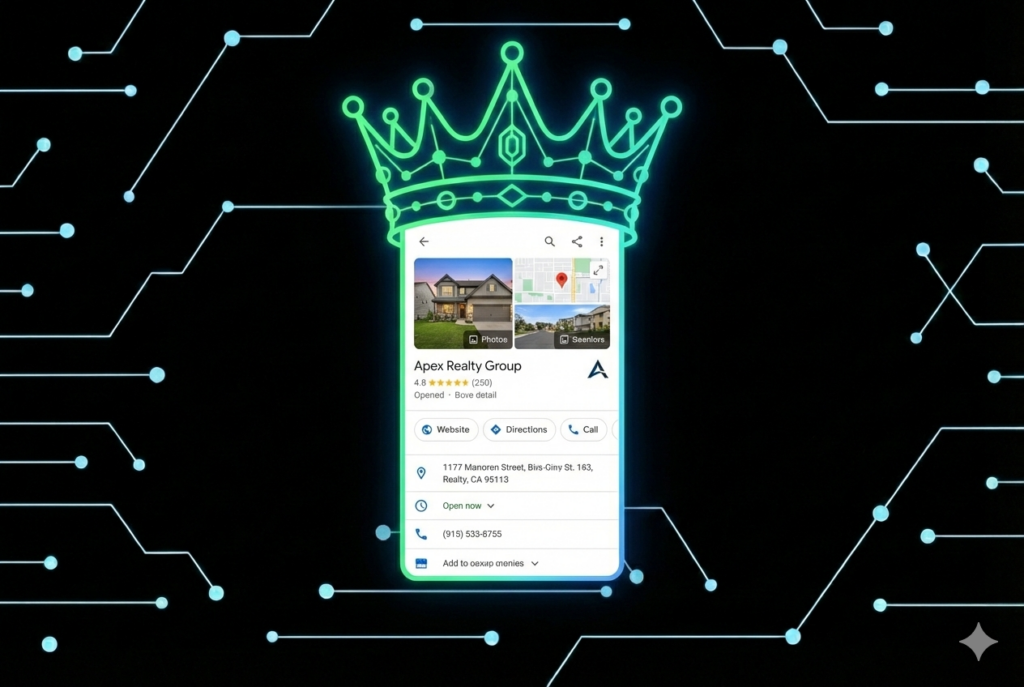
In 2026, your Google Business Profile isn’t just a “listing.”
It has almost replaced your website (or let’s say become just as important) as the primary conversion point.
If you aren’t in the “Top 3” of the Map Pack in the surrounding radius of your office, you are essentially invisible to about 90% of your potential market. It doesn’t matter how good your “GEO” strategy is if you don’t show up when someone types “property management near me” in Google.
This is a habit engrained in us and it’s not changing quickly, at least not anytime soon.
The “GEO” Debate: Is it Just Rebranded SEO?
You’ve probably heard “experts” talking about Generative Engine Optimization (GEO).
They claim it’s a whole new thing required to show up in AI answers.
SEO is alive and well. Checkout this data below from Google Search Console for the last 3 months and the increases in exposure and clicks for one of our sites.

Here is the unspoken truth about it: GEO is like 80%+ rebranded SEO.
The AI models (like Gemini or Perplexity) that provide these “answers” aren’t magical. They are aggregators and they are just using a lot of data from Google (even though Bing is the provider for ChatGPT, it still matches up with Google data.)
Why? They don’t have their own search engines to pull data from.
When an AI tells a user, “Property Manager X is the best choice for luxury condos in downtown Austin,” it isn’t really “thinking.” It’s looking (insanely fast) at all the managers on Google and noticing the fact that Property Manager X has 45 reviews mentioning “luxury,” “downtown,” and “Austin” on their Google Business Profile.
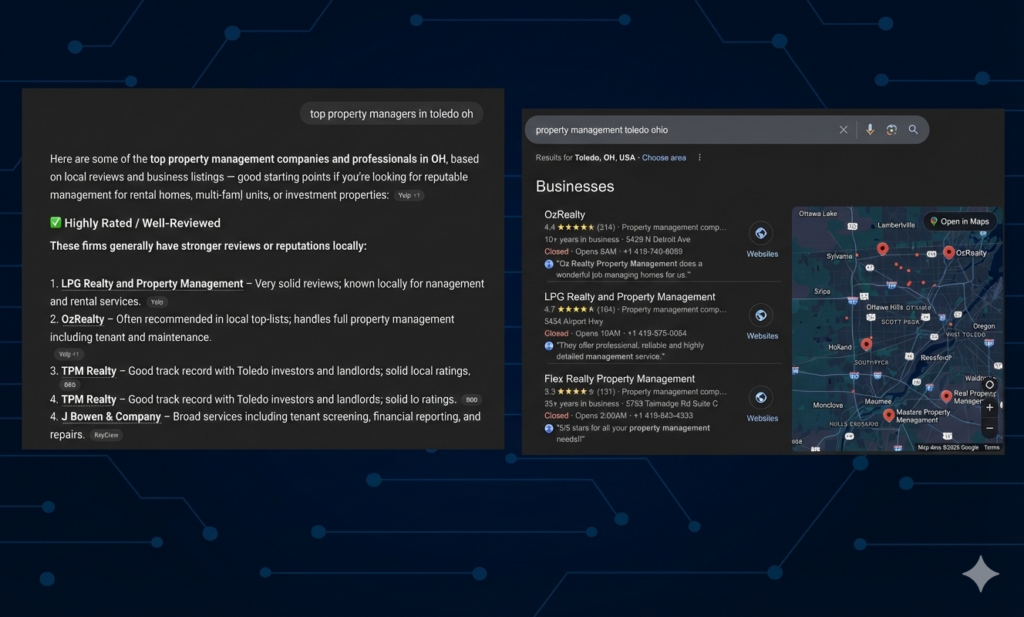
The industry (and the sheep that followed) tried to give AI optimization a fancy new name to sell more to scared business owners, but the fundamentals remain the same: If you win at local SEO with your Google Business Profile, you basically win at local business searches in AI by default.
Compare the below similar property management searches on Google and ChatGPT, you can see very similar results:
The Rise of “Validation Search”
The way property owners use search has changed, but not in the way most people think. We’ve moved into the era of the validation Search.
In 2024, people were doing more searching to find options. In 2026, people search to eliminate options.
Even if a potential client doesn’t hear about you online first, what they are going to do is head there to likely check out your listing and your website to get a better idea of what you’re about, and if you guys have a track record of happy clients or an online presence that makes them wonder if you are even in business anymore.
- A “Ghost Town” Profile: Last review was like 8 months ago, no new photos in several months or more, and a generic “About” section.
- A “High-Pulse” Profile: 5 new reviews this month, a video post from a week or so ago discussing local market trends, and dozens of high-resolution photos of actual properties you’ve had on the market or currently manage.
In 2026, Google (and property owners) are looking for “proof of life.” They want to know that if they hire you, you are active and engaged in the market right now and will be there for your property when it matters.
5 Strategies for Maximum Exposure (That Actually Drive Leads):
If you want to dominate in your local market and capture that 80% – 90% or more of owners still relying on Google, you need to move past a “set it and forget it” marketing approach. Here are five things that are moving the needle for our top performing agents and property managers in 2026.
1. The “Living Profile”: Hyper-Active GBP Management
In 2026, Google rewards a pulse/engagement. A GBP that was updated three months ago is considered “MIA” by the algorithm. To stay in the Top 3 in your local radius, your GBP needs to be a living, breathing ecosystem of information that’s staying fresh.
- The Strategy: Treat your GBP like some kind of a social media feed. This means uploading at least a few new photos weekly. Not stock photos, but boots on the ground kind of stuff. Photos of a new lease signing, a renovated property about to hit the MLS, or team activity around the office.
- Why it works: Every time you upload a geo-tagged photo or update your info, you are sending a signal to Google that your business is active and alive. In a world of old school companies and AI-generated BS, genuine activity is the ultimate way to show reliability.
2. Review Velocity: The Drip Over the Surge
One of the biggest mistakes realtors and property managers make is “Review Spiking.” They are so busy doing their thing, they forget to be consistent on review requests, and send out a blast email once a quarter, get dozens of reviews in 48 hours, and then get zero for the next couple months again.
In 2026, Google’s spam filters are hyper-sensitive to these bursts, and we’ve even seen clients who swore they left a review but it doesn’t show up publicly. Google sees this surge, it looks suspicious, and they get more sensitive about gauging which reviewers are legit or not.
- The Strategy: Focus on Review Velocity, the steady, consistent arrival of real new reviews. Aim for something 2-3 reviews per week, every week, like clockwork (this depends on how many clients you serve etc but you get the point)
- Why it works: A steady stream of reviews tells the algorithm that you are consistently doing business, and providing good service. A sudden “burst” looks like a paid manipulation campaign. Consistent velocity builds trust equity that is much harder for competitors to knock down.
3. Local and Niche Mentions/Links: Building the “Digital Moat”
Backlinks still matter, but generic links from “Business Advice Blog Dot Com” are pretty much worthless in 2026. Google now puts a lot more emphasis on Contextual Relevance.
- The Strategy: Go deep, not wide. Get mentioned on the local Chamber of Commerce site, the neighborhood association blog, a local news outlet’s “Small Business Spotlight”, or other brokerages outside your zip codes (your direct competitors in town won’t mention or link to you if they are smart). Even a link from a local high school sports sponsorship carries more “Local Authority” weight than a high DR (domain rating) link from a site in another country.
- Why it works: These links prove to Google (and then the AI scrapers) that you are a legitimate entity within a specific geographic boundary. It builds a “Digital Moat” around your service area and the real estate industry. Local relevance and niche relevance are carrying a lot more weight than they used to.
4. Cluster Blogging: High-Value Local Knowledge Hubs
Generic blog posts like “How to increase property value” are dead and have been written hundreds of times already. Plus, AI already wrote a better version of that for free in about 3 seconds. In 2026, you win by building Local Value Clusters.
- The Strategy: Create a “hub and spoke” content model. Your “money pages” which is usually your home page and maybe a few others (ex Property Management Services in Phoenix) is the Hub. Your “spokes” are ultra-specific local guides: “The 5 Best Neighborhoods for Mid-Term Rentals in Scottsdale” or “How the New Phoenix Zoning Laws Affect Multi-Family Owners.” The Key: Interlink these “spokes” blogs back to your “money pages” with specific anchor text that’s natural and describes the page the hyperlink points to.
- Why it works: This tells Google you aren’t just a service provider; you are a local subject matter expert. When your “Value Clusters” get traffic and links/mentions, that authority “leaks” onto your money pages through those interlinks, pushing them higher in the search results by building topical authority and helping Google even better crawl and understand exactly what each page is focused on.
5. Social Activity & YouTube: The Search Engine Synergy
Google owns YouTube. In 2026, this is one of the ultimate “cheat codes” for real estate professionals. Video is the only medium that AI still struggles to replicate with 100% human authenticity, and Google loves to rank videos in their search results as the third most prevalent source in search results. If you create good content, you get to piggyback on the authority of Youtube, giving yourself a great shot at first page video placements in the SERPs (search engine result pages).
- The Strategy: Every local “Cluster” blog post should have a companion YouTube video. Embed that video on the page and share it on LinkedIn and your GBP.
- Why it works: YouTube videos often appear in the “Video Carousel” on Page 1 of Google. By owning the video result and the GBP result, you are taking up more “digital real estate” than your competitors. It also provides that crucial “Proof of Life”, an owner can see you, hear your voice, and decide if they trust you before they ever hit “Contact.” You’ll even have something funny happen where new leads will come in, and when you talk to them, they’ll act like you know each other. This is because through seeing your video content, they’ve kind of “met you” already.
FAQ’s: Agents, Managers, & The 2026 Marketing Shift
Q: Is my website still relevant if most leads come from my Google Business Profile?
A: Absolutely. Think of your GBP as the “hook” and your website as the “closer.” The owner will find you on the map, but they will click through to your website to see your specific services, fees, how you “tell your story”, your team bios, and ultimately fill out the actual form or call. Your website needs to be the “Deep Dive” that confirms their decision to reach out. Not only that, if your listing isn’t linking to a site that is optimized and “backs up” the info you have on the listing, it won’t rank and you won’t even get exposure in the first place. Your website can’t do without your GBP, and your GBP can’t do without your website.
Q: Should I worry about ChatGPT and Perplexity stealing my traffic?
A: For “Top of Funnel” info (like “What are the eviction laws in Florida?”), yes, AI will take that traffic. But for “Bottom of Funnel” intent like “Who can manage or sell my 10-unit building in Orlando?”, Google Maps is still the primary destination. Focus on the high-intent keywords, and let the AI handle the “how-to” questions.
Q: Does “AI-generated” content on my blog hurt my Google Business ranking?
A: Not directly, but it hurts your conversion. If a property owner reads a blog post on your site that sounds like a generic robot, they will assume your management style is equally robotic and disconnected. Use AI for outlines, but always inject your “Boots-on-the-Ground” perspective. Something else to consider; when AI content started getting popular, Google decided to devalue it compared to human generated content. The current state in 2026 is “whether its human generated or AI generated, whatever is best wins”. But, you never know what the future holds, and because of that, we stick to human generated content just to be safe.
Conclusion: Trust Beats Technology
The tools we use to find professionals have evolved, but the psychology of the property owner remains unchanged. They are looking for authority and proximity.
Google Business Profile remains the king because it is the only platform that perfectly marries those two things. While the “AI or Google” debate will continue to rage in marketing circles, the most successful real estate pros in 2026 aren’t picking a side. They are doubling down on the one platform that property owners actually trust to show them who is “real” in their neighborhood.
Don’t get distracted by the rebranding of SEO as “GEO.” Focus on the pulse of your business, the quality of your reviews, and the consistency of your local presence.