



Building for hospitality in New York City is not a test of whether a contractor can execute. It is a test of whether they can execute under conditions that most projects never face.
Occupied hotel floors directly above an active build, century-old buildings requiring multi-agency coordination, brand standards that cannot be approximated, and opening dates that are non-negotiable.
The projects below represent five distinct moments in Blueberry Builders’ portfolio where those pressures were fully present. Each delivers a different lesson in what hospitality construction and renovations in NYC require at the highest level: not just craftsmanship, but the operational, regulatory, and design intelligence to make that craftsmanship land on time and on brand.
1. Hyatt Union Square
Bowery Road and the Library of Distilled Spirits
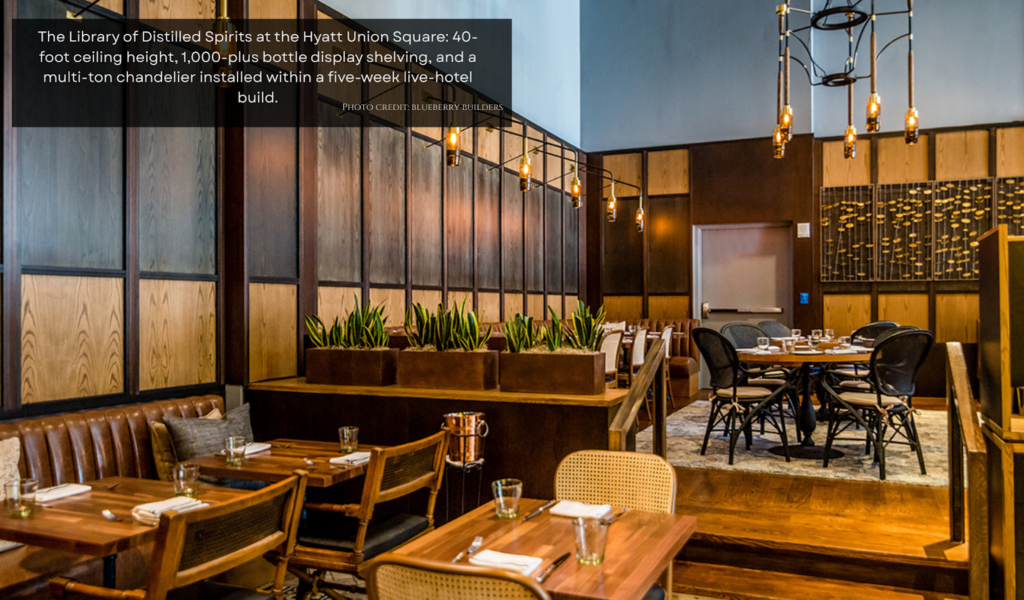
The brief was unambiguous. Deliver 10,000 square feet of restaurant and bar space inside a functioning luxury hotel in five weeks.
Maintain guest experience throughout. Match the architectural ambition of Dutch East Design’s concept, which included a 40-foot ceiling height exploited to its maximum, glowing lockable library shelving for over 1,000 spirit bottles, a communal library table beneath a large suspended chandelier, and a copper-topped bar finished to develop the kind of patina that evokes New York’s historic drinking rooms.
The chandelier installation alone was a structural and logistical problem.
Hanging a multi-ton fixture within an occupied building, coordinating with hotel management on access windows, and executing metalwork and millwork to the precision the design required, all simultaneously, is the kind of scope that tests whether a contractor’s project management infrastructure is genuinely built for complexity or simply built for normal conditions.
The ash wall panelling in the downstairs special events area and the precision cabinetry spotlighting the spirit collection represent the finished quality Blueberry Builders brought to a project where a single visible shortcut would have been immediately apparent to every guest in the room.
Key elements:
- Scope: 10,000 sq ft restaurant and bar buildout within an operating Hyatt hotel
- Schedule: Five weeks, construction with minimal disruption to hotel guests
- Key elements: Multi-ton chandelier installation, 1,000+ bottle spirit display shelving, copper bar, ash wood wall panelling, precision cabinetry
- Design Partners: Dutch East Design
- Location: Hyatt Union Square, Manhattan
2. Maison Kayser
Brooklyn's Downtown Courthouse

French master pastry chef Eric Kayser’s first Brooklyn location brought with it two simultaneous design challenges: the need to honour the Maison Kayser brand identity with precision, and the need to do so inside a century-old building that had not been designed to accommodate a modern commercial kitchen and dining operation.
The gut renovation created a full-service bakery at the front and a sit-down French bistro at the rear. The design language was specific: Moroccan tilework, custom steel and glass partitions fabricated to the brand’s exacting specifications, and a warmth of finish that communicated artisan quality without sacrificing operational functionality.
The more technically demanding dimension of this project was beneath the surface. Coordinating venting, electrical, and plumbing trades within the existing fabric of a historic courthouse building required constant communication across multiple City agencies. Older buildings do not yield to modern mechanical requirements without resistance. The ability to navigate those constraints, maintain the design brief, and keep the project on schedule is precisely the capability that separates contractors with genuine historic building experience from those without it.
Key elements
- Scope: Full gut renovation, bakery and bistro buildout within historic Brooklyn courthouse
- Key elements: Moroccan tilework, custom steel and glass partition fabrication, full MEP coordination
- Complexity: Multi-agency coordination for venting, electrical and plumbing within a century-old structure
- Brand: Maison Kayser (Eric Kayser)
- Location: Downtown Brooklyn / Downtown Courthouse
3. L’Artusi Supper Club
West Village precision under a tight schedule

When L’Artusi’s ownership decided to expand their West Village presence by creating a private supper club at 105 Christopher Street, they engaged a designer whose work spans celebrity residences and international projects with Ralph Lauren.
Elizabeth Bolognino Interiors conceived a space that looked to the historical figure of Pellegrino Artusi for its formal register and to the interior language of a luxurious train car for its spatial logic.
The defining architectural element was a mirror running the full length of the ceiling, creating the illusion of width within a narrow footprint and discreetly concealing the HVAC infrastructure required for a functional dining operation. Every surface carried custom finishes and details. The carpentry brief was, by any measure, demanding.
What made this project newsworthy in construction terms was the schedule. Opening in early 2024, the renovation was completed and turned over in record time, a constraint that required Blueberry Builders’ carpentry team to execute custom finish work at a pace that is genuinely difficult to achieve without both technical skill and project management discipline. The space seats thirty guests and operates as both a private event venue and a regular supper club for the L’Artusi group’s communal dining programme.
Key elements
- Scope: Renovation and fitout for private dining and supper club use
- Programme: 30-seat private dining room with bar, custom HVAC concealment, full carpentry package
- Design partner: Elizabeth Bolognino Interiors
- Location: Christopher Street, West Village, Manhattan
- Opened: 2024
4. Milk Bar Flagship
Brand-identity construction at the Ace Hotel, NoMad
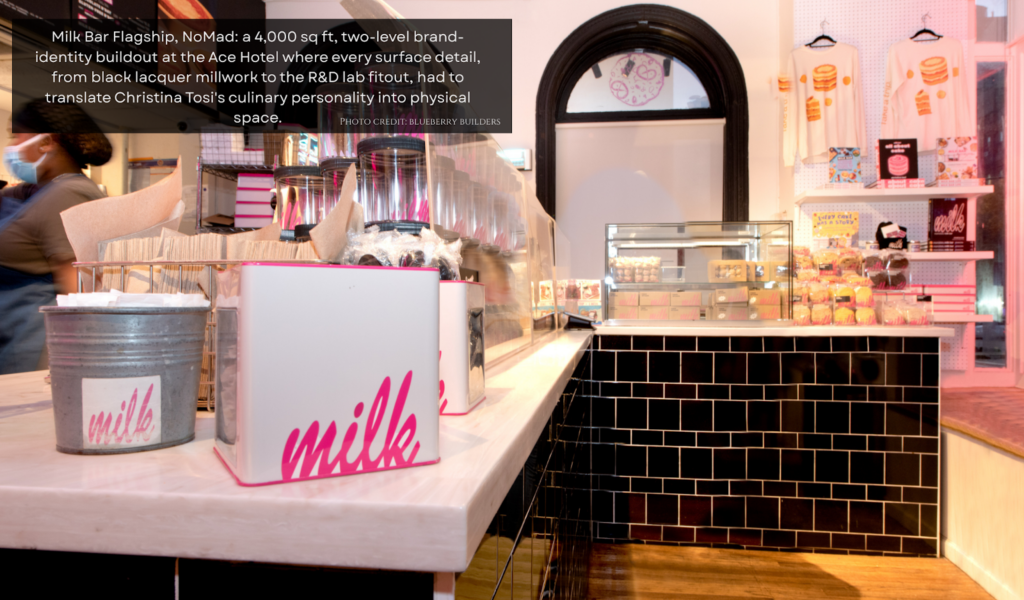
The Milk Bar Flagship at 1196 Broadway in NoMad is one of the more technically specific briefs in the Blueberry Builders portfolio, because the construction challenge here was not purely about scale or regulatory complexity.
It was about translation: converting a highly specific brand identity, built around irreverence, precision baking, and a playful design sensibility, into a two-level, 4,000-square-foot retail and food-service environment inside the Ace Hotel.
Milk Bar’s largest location to date at the time of build, the flagship was conceived as a multi-zone experience across two floors. The ground level housed the primary retail and service counter programme.
The lower floor contained a classroom space, complete with a disco ball, designed for public baking workshops, alongside an R&D test kitchen where product development happened in view of guests.
Each zone carried its own fitout requirements: millwork and display counter specifications for the retail floor, kitchen equipment and worktop installation for the production areas, and the kind of feature detailing that makes a space recognisable rather than generic.
The construction task was to execute those panels with the surface consistency and reveal tolerances that lacquer finish demands, within the sequencing and timeline constraints of building inside an operational hotel.
Key elements
- Scope: 4,000 sq ft, two-level flagship retail and food-service buildout
- Location: 1196 Broadway at 29th Street, Ace Hotel NoMad, Manhattan
- Key elements: Lacquer millwork package, display counters, R&D test kitchen fitout, classroom space with feature ceiling detail
- Brand: Milk Bar (founded by chef Christina Tosi)
- Complexity: Multi-zone construction within operating hotel, brand-identity finish standards
5. Rosa Mexicano TriBeCa
Two-level cantina with Dutch East Design

The Rosa Mexicano TriBeCa project brought together two of the most demanding elements in high-end restaurant construction: a multi-level renovation with distinct atmospheric programming on each floor, and a design concept that required sourcing and installing authentic materials directly from Guadalajara, Mexico.
The design brief, developed by Dutch East Design, the same studio behind Blueberry Builders’ Hyatt Union Square work, called for a stylish flagship that merged the language of a French bistro with a traditional Mexican hacienda. Upstairs, an intimate dining room and bar was designed to showcase Rosa Mexicano’s regional Mexican cuisine.
Downstairs, the subterranean Masa y Agave mezcaleria was conceived with the communal energy of a local Mexican cantina, complete with a corn masa bar snacks programme from a dedicated Masalogist and an agave spirits collection running to 400 bottles of tequilas, mezcals, and lesser-known expressions.
Delivering two experientially distinct floors within a single building envelope requires careful sequencing of structural, MEP, and finish work. The bar and kitchen service infrastructure for both levels had to be coordinated without the two programmes conflicting during installation. The authentic sourced elements from Guadalajara, including decorative pieces that referenced the cantinas of the region, required careful coordination with freight and installation schedules to land on time and in condition. The result is a space where the construction is invisible in the way it should be: all that is visible is that the design intent was fully realised.
Key elements
- Scope: Two-level restaurant renovation with distinct upstairs dining room/bar and subterranean mezcaleria
- Design partner: Dutch East Design
- Programme: Upstairs dining and bar (Rosa Mexicano), downstairs cantina and spirits programme (Masa y Agave)
What these projects have in common
Five projects. Five entirely different briefs.
What connects them is not a signature look or a recurring material palette. It is the operational consistency that allows a contractor to move between those five scopes, serve five different design visions, navigate five different sets of regulatory and logistical constraints, and deliver to the standard each client’s brand demands.
That is the capability that the hospitality sector reveals, because it is the one sector where the finished product is immediately and continuously reviewed by the people who use it.