

Let me make this simple: if you’re a real estate agent trying to get inbound leads online, your success or failure starts with local SEO.
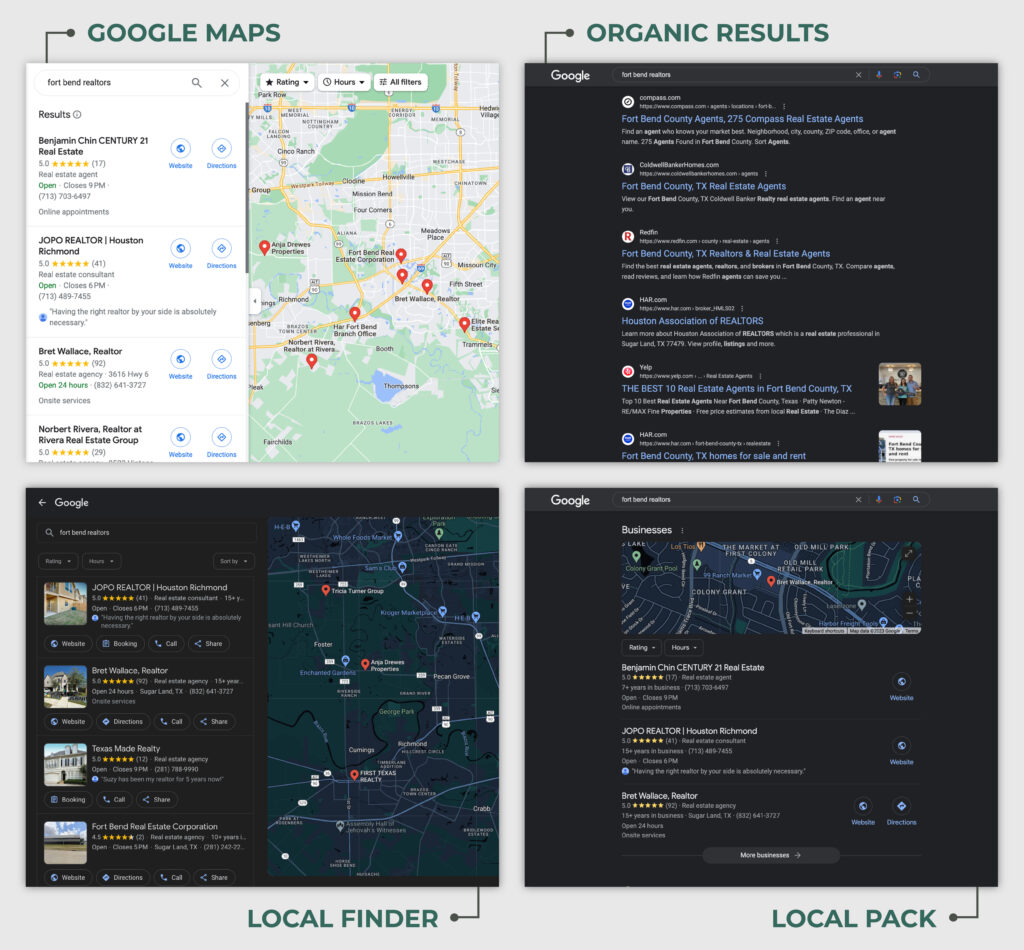
The Local Pack—the three little business profiles at the top of a Google search—is the new front page of the newspaper. Show up there, and your phone rings. Miss it, and Zillow takes another commission check that should have been yours.
Local SEO for realtors can also mean targeting Google Maps results, organic search, and the Local Finder.
Google isn’t ranking you based on how pretty your website looks. It’s ranking you based on three blunt factors:
- Relevance – Do you match the search query?
- Proximity – Are you close enough to the searcher’s location?
- Prominence – Do you look like a trusted authority?
You can’t move your office closer to every lead in town. But you can outwork and outsmart your competition on relevance and prominence. That’s what this playbook is about—practical steps that get you seen where it matters most.
Local SEO ≠ Traditional SEO (What Changes for Realtors)
Most agents confuse the two. They try to copy e-commerce strategies, pumping out generic blog posts and hoping Google takes notice.
Here’s the difference:
- E-commerce companies rank product pages.
- Realtors rank Google Business Profiles (GBPs) and hyperlocal content.
That means two main battlegrounds:
- The Local Pack – those three GBP listings pinned on the map.
- Organic search results – your website pages, blogs, and neighborhood guides.
And here’s a unique twist for our industry: Google allows practitioner listings. That means your agents can have their own GBP separate from your brokerage. Done right, you own more real estate on page one. Done wrong, you split authority and lose visibility.
Bottom line: a website alone isn’t enough anymore. Without an optimized GBP, consistent directory listings, and a steady stream of keyword-rich reviews, you won’t dominate your market.

Why Reviews Are the Secret Weapon
Every agent knows reviews build trust. What most don’t realize is that reviews are also one of the heaviest weighted ranking factors in Google’s Local Pack.
Google doesn’t just count how many five-star reviews you have. It scans the actual language inside those reviews and bolds the words that match what buyers and sellers are searching.
Check out the official Google guidelines below.

But this wording is Google playing their cards close to their chest.
I did a case study of hundreds of real estate agent Google Business profiles to uncover the secret sauce of the algorithm.
What I found out is the difference between showing up in the Top 3 or being buried on page two can come down to a single phrase like “best realtor in San Diego.” I’ve seen agents jump hundreds of spots just because a handful of clients used those exact words in their reviews.
If you take nothing else from this playbook, remember this: reviews aren’t just social proof—they’re SEO fuel.
The “Best Realtor” Hack
I discovered this by accident while running tests across multiple markets. Agents who couldn’t rank in the Top 300 for “realtor in [city]” suddenly landed in the Top 3 when the searcher typed “best realtor in [city].”
Why? Because Google’s algorithm heavily rewards exact-match keywords in reviews.
Here’s what that looks like in practice:
- An office 20 miles outside Jacksonville still cracked the Local Pack because clients wrote “best realtor in Jacksonville” in their reviews.
- A small brokerage in Louisville jumped from obscurity to the #2 spot with just three reviews containing “best real estate agent.”
This isn’t theory. This is tested, repeatable, and wildly underused. I’d bet 95% of agents in your market aren’t paying attention to it.
When Hyperlocal Beats the Odds
The wildest example I’ve seen? A property management company with a mediocre 3.6-star rating outranked two five-star real estate agencies for searches in a Kansas City suburb. Why? One single review contained the suburb’s name.
That’s how much weight Google gives to keywords in reviews. It can override distance, rating, even business category.
If you aren’t leveraging this, you’re leaving money on the table.
Technical GBP Optimization (Fast Wins)
- Pick the Right Categories
Set your primary category to “Real Estate Agent” or “Real Estate Agency.” Add one or two relevant secondary categories to expand reach. - Nail Your Business Info (NAP)
Ensure your Name, Address, and Phone exactly match across your website and every directory. No typos, no variations. - Use Rich Media
Upload quality photos and short videos—team shots, property tours, closing-day smiles. Google rewards active profiles. - Post Regularly
Share listings, market updates, insights, or blog teasers. You don’t need perfect content—just consistent posts. - Respond to Reviews Intelligently
Don’t just “thanks!” Mention neighborhoods, echo keywords, offer contact. Every response is a mini signal to Google. - Be Strategic with Practitioner Listings
Agent-level profiles can boost visibility—but only if managed smartly. Avoid overlap and internal competition. - Build Local Authority with Links & Citations
Earn mentions from local sites (news, schools, associations). Ensure citations (Yelp, Realtor.com, directories) all match your NAP.
Want a plug-and-play GBP setup checklist? Here’s my full guide to setting up a Google Business Profile for real estate agents: InboundREM GBP Setup Guide.
Schedule a Meeting
Let’s chat about how an SEO-focused website that YOU OWN, Google Business Profile Campaigns, or Custom Email Campaigns can generate high-quality leads and exceptional long-term ROI. If my services aren’t the best move for you, I’ll gladly point you in the right direction
Categories: The Silent Killer of Rankings
Your primary business category is one of the top three ranking factors. If you’ve got the wrong one, you’re handicapping yourself right out of the gate.
- Primary category: Always set this to “Real Estate Agent” or “Real Estate Agency,” whichever reflects your actual practice.
- Secondary categories: Use them to cover specialties—“Property Management Company,” “Commercial Real Estate Agency,” “Real Estate Consultant.” Don’t overdo it, but do cover your bases.
Here’s the pro tip: secondary categories won’t rank you for brand-new searches on their own, but they’ll expand the net of what Google thinks you’re relevant for. That can be the difference between showing up for “luxury real estate agent” vs. just “real estate agent.”
Business Info: NAP Consistency
Google is obsessed with consistency. Your Name, Address, and Phone (NAP) have to match exactly across every platform—your website, Zillow, Realtor.com, Yelp, Facebook, and all the citation directories. One typo, one old phone number floating around, and Google starts doubting your legitimacy.
I’ve seen agents lose rankings because their brokerage name was listed three different ways. Don’t let that happen to you. Audit your citations at least twice a year.
The Site That Supports Your GBP (and Steals Portal Traffic)
Neighborhood Pages That Actually Rank
If your “neighborhood page” is just a static MLS feed, you’ve already lost. Zillow will eat you alive. To win, your page anatomy needs:
- A live IDX grid paired with a custom map.
- School lists, commute times, and micro-market stats.
- Lifestyle content with real photos and commentary.
- Internal links to sub-areas.
Add jump links and FAQs so people (and Google) find answers fast. Then keep updates rolling — if a coffee shop closes, your page should reflect it before the competition.
Content Clusters & Pillars
Google rewards structure. Instead of scattering posts, build a system:
- Pillar: “Living in [City]” or “Home Buying in [City]” — the hub.
- Clusters: schools, taxes, utilities, cost of living, “best neighborhoods,” parks, restaurants.
- Link pattern: cluster → pillar → neighborhood pages → listings.
Done right, you create a web of authority Google can’t ignore.
Internal Linking That Moves Needles
Links are votes. Use descriptive anchors like “best neighborhoods in Orlando” — not “click here.” From every new post, link to at least:
- One pillar page.
- One neighborhood page.
Inline CTAs push even harder. Example: “See how we outranked portals for ‘Homes for Sale in West Lake Okoboji’.” That’s how you funnel authority to the pages that print leads.
Keyword Strategy That Doesn’t Waste a Year
Long-Tail, Hyper-Local First
Don’t waste twelve months chasing broad terms like “real estate tips.” You’ll get traffic and zero clients. Instead, pull from my 350 real estate keywords and cluster by intent + geography.
One big article on “Moving to Austin” can capture dozens of search variations. Five deep posts that cluster related terms will beat thirty thin ones every time.
What Belongs on a Blog vs. a Landing Page
The rule of thumb:
- Landing pages are for “homes for sale in [Neighborhood].” They need IDX grids, deep local content, and conversion features.
- Blogs are for informational intent like “Moving to [City]” or “Best schools in [City].” Pack them with data tables, maps, and internal links to the landing pages.
Stop guessing what goes where. If the intent is listings, it’s a landing page. If it’s lifestyle, cost, or schools, it’s a blog.
How to Get Keyword-Rich Reviews Without Sounding Fake
Now, don’t panic. I’m not telling you to hand clients a script and beg them to copy-paste it. Google can smell manufactured reviews a mile away.
What you can do is lightly coach clients:
- Pick the right moment—closing day is perfect.
- Explain why reviews matter for your business. Most people genuinely want to help.
- Offer a couple of examples: “It helps if you mention the city or say something like I was the best realtor you’ve worked with.”
The key is making it natural. A short, vague “great agent” review won’t move the needle. A 100- to 200-word review that mentions your market and calls you the “best realtor” can pay for itself a hundred times over.
Hyperlocal Keywords: Neighborhoods, Suburbs, and Communities
Most agents obsess over city-wide searches. That’s fine, but it ignores the fact that buyers rarely type just “realtor in Dallas.” They’re searching:
- “realtor in Mira Mesa”
- “homes for sale in Ballard”
- “best real estate agent in Summerlin”
And here’s the kicker—Google rewards agents who have those exact neighborhood names mentioned in their reviews.
I’ve tested this across the country, and every single time the agent who ranks #1 has more reviews containing hyperlocal language than their competition. Sometimes they even beat agents who have more reviews, better ratings, and offices closer to the neighborhood.
I’ll give you an example. In San Diego, an agent based ten miles away from Mira Mesa ranked above agents physically located in Mira Mesa. Why? Because one review mentioned the neighborhood by name. And that review wasn’t even from a buyer who closed there—it was from a referral. The algorithm doesn’t care; it just sees the keyword.
That’s how powerful this is.
Why Almost Nobody Is Using This Hack
When I ran hundreds of searches, I found almost no agents intentionally doing this. Maybe one in fifty reviews mentioned a neighborhood or suburb by name. Which means if you’re the one who starts asking for them, you immediately stand out.
Think about it: most clients are happy to get specific. If they bought a home in Summerlin, they’ll gladly write “best realtor in Summerlin” in their review—it just takes a nudge from you to remind them.
How to Put This Into Action
Here’s what I’d do if I were you:
- Make a list of 10–15 neighborhoods you want to dominate.
Don’t just pick the wealthy ones—include up-and-coming areas where competition is thin. - Work those names into your coaching.
“If you could mention that we helped you buy in [Neighborhood], it helps other people searching in that area find me.” - Track your results.
Use BrightLocal grids or even just incognito searches in Google Maps. Watch how a single hyperlocal keyword in a review can move you from invisible to the Local Pack.
This is the definition of low-hanging fruit. You don’t need hundreds of reviews. You just need a handful of well-placed ones with the right language.
Links That Matter Locally
Forget chasing random backlinks. Zillow has 10 million of those. What moves the needle for you are local trust signals:
- Sponsorships (youth sports, community events)
- Chambers of commerce and industry associations
- Local news quotes where you’re the expert
- Neighborhood guides that others can cite
Build a quarterly outreach calendar. Track referring domains, not just link count—one backlink from your city’s paper beats 100 junk directories.
Technical & Mobile: Don’t Lose the Win After You Earn It
Getting found is half the battle. Keeping people on your site is the other half. That means:
- Core Web Vitals: speed, stability, responsiveness
- Image compression (WebP), lazy load
- Sitemap/robots.txt done right
- Canonical cleanup, no duplicates
- Local business schema
Rule of thumb: speed before pretty. Your site has to work on mobile first, or it doesn’t work at all.
What Not to Do (Still Common, Still Deadly)
I’ve been in real estate SEO long enough to watch Google torch entire businesses for cutting corners. Agents still fall into these traps because they’re “fast” or “cheap.” Here’s what to avoid if you care about long-term ROI:
- Doorway city pages. Cloning the same “Homes for Sale in [City]” template 50 times with nothing unique. Google knows. They’ll deindex you.
- Keyword stuffing. Writing “Dallas homes for sale” twelve times in one paragraph doesn’t help—it kills readability and signals manipulation.
- Spun content. AI or cheap outsourcing that rewrites the same blog five ways. It reads like garbage and won’t rank.
- Bought links. Those $99 “1,000 backlink” packages? They leave a toxic footprint. Google’s algorithms (and manual reviews) will burn them.
- Over-optimized anchors. If every backlink says “best Miami real estate agent,” you’re toast. Mix it up with natural anchors.
- Scraped MLS listings. Copy-pasting IDX data without adding local insight. Zillow already has the listings; your job is to layer expertise and context.
- Review gating. Only sending review requests to happy clients is against Google policy. If they catch you, they’ll pull your profile.
Bottom line: if it feels like a shortcut, it probably is. Real estate SEO is one of the most competitive verticals online. You don’t beat trillion-dollar portals with tricks—you beat them with trust, authority, and consistency.
Schedule a Meeting
Let’s chat about how an SEO-focused website that YOU OWN, Google Business Profile Campaigns, or Custom Email Campaigns can generate high-quality leads and exceptional long-term ROI. If my services aren’t the best move for you, I’ll gladly point you in the right direction
FAQ (Local SEO for Realtors)
How many reviews do I need to rank in the Local Pack?
You want momentum more than totals. I tell clients to sprint to 40 reviews as fast as possible. After that, maintain a steady 1–2 per week. The steady drip tells Google you’re active and trustworthy.
Should each agent have their own Google Business Profile?
Yes, but carefully. Google allows individual practitioner listings, but unmanaged, they can compete with your office profile. The fix: give every agent a clear NAP (Name, Address, Phone) strategy, and interlink them smartly. Done right, it multiplies your reach. Done wrong, it dilutes your signals.
Can I beat Zillow/Redfin for “homes for sale” terms?
For citywide terms like “Los Angeles homes for sale,” no—you won’t touch them. For hyper-local, like “Venice Beach bungalows for sale”? Yes. With IDX-backed neighborhood pages, strong GBP presence, and consistent reviews, I’ve watched small brokers outrank portals in their backyard.
What’s the best star rating target?
Shoot for 4.8 to 4.9. A wall of perfect 5.0s looks fake. Buyers trust a mix of glowing reviews and the occasional four-star with a thoughtful response from you. That response builds more trust than the stars alone.
How fast can I see results from neighborhood pages?
Expect 3–6 months before Google trusts the page enough to drive meaningful traffic. Leads usually lag—plan on 6–12 months for a neighborhood page to start delivering consistent calls and form fills. Add fresh updates (like new restaurants, school ratings, or market stats) every quarter to speed that timeline.
Do I need separate websites for multiple cities?
Not unless you’re spanning states or running distinct brands. One site with robust location pages is the right play 90% of the time. Separate sites split your authority and double your workload.
Are paid directories like Yelp worth it for SEO?
For direct leads, maybe. For SEO authority, not really. Google cares more about consistency (your NAP being identical across top directories) than premium placements. Start with free high-authority listings before you ever spend on “featured” spots.
What if I already have bad backlinks?
Don’t panic. Run an audit (Ahrefs, SEMrush, or even Search Console). If you’ve got spammy links, disavow them through Google. Then rebuild with local, high-quality links—community organizations, local press, business partnerships.
Lorem ipsum dolor sit amet, consectetur adipiscing elit. Ut elit tellus, luctus nec ullamcorper mattis, pulvinar dapibus leo.